Login

The smart home has never lacked devices. It has lacked coordination.
Homes now include smart locks, cameras, sensors, speakers, lighting systems, appliances, and energy devices. Yet the user experience is still often fragmented across different apps, accounts, platforms, wireless protocols, cloud services, and support channels.
For broadband service providers, this raises a strategic question: If the home is becoming increasingly digital, who will manage the infrastructure layer that keeps it reliable, secure, and serviceable?
The answer may not be a single app, smart speaker, or device brand. Increasingly, the broadband home gateway is becoming a strong candidate — because it sits at the center of the home’s digital infrastructure.
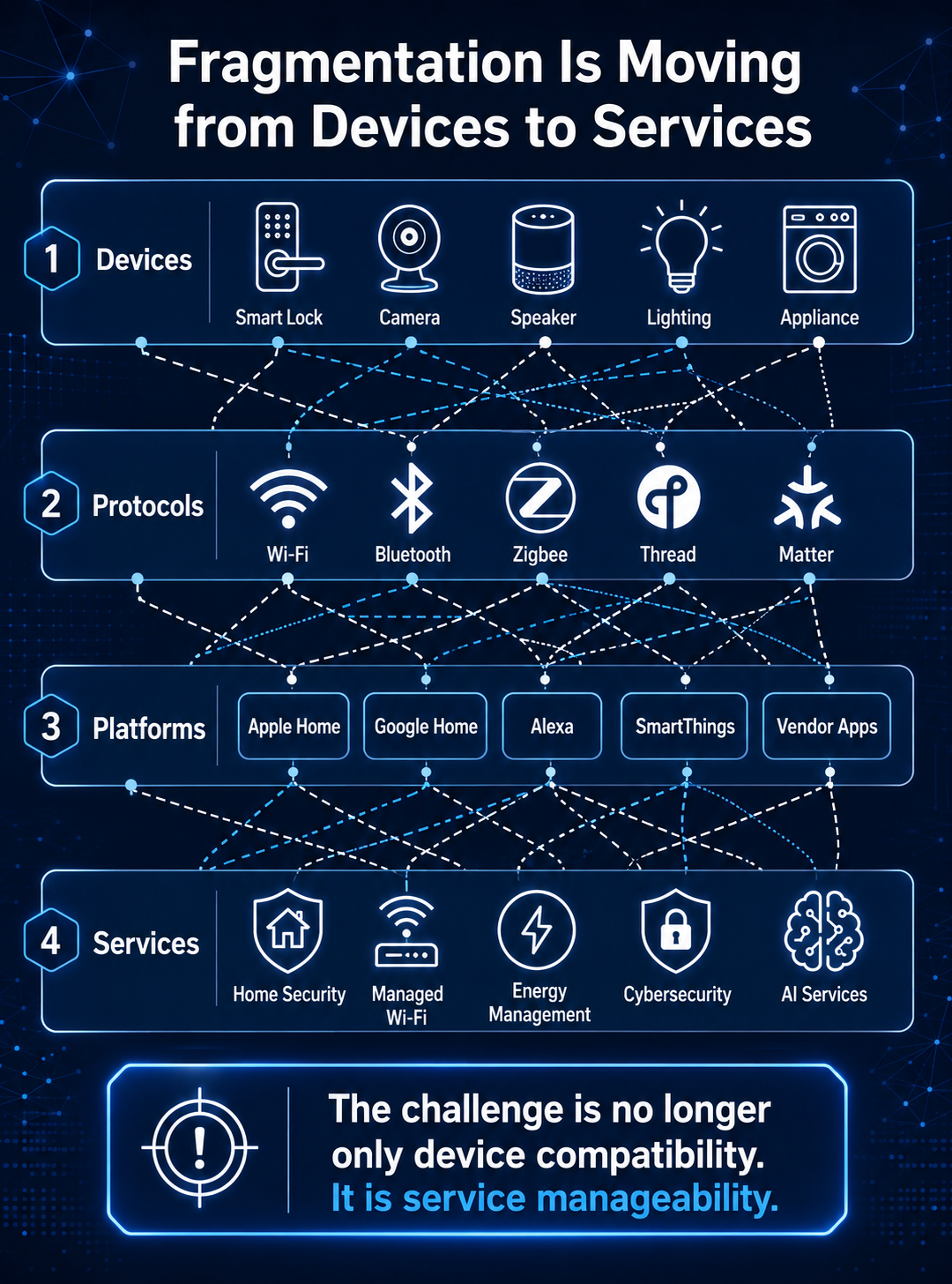
Smart home fragmentation is often seen as a device compatibility issue. But the deeper challenge is service management.
Fragmentation exists across devices, protocols, platforms, and services:
So the key question is no longer only whether devices can connect. It is whether connected home services can be managed, monitored, maintained, and improved over time.
Matter is an important step forward. The Connectivity Standards Alliance defines Matter as a unifying, IP-based connectivity protocol designed to support reliable and secure IoT ecosystems. It helps improve interoperability across smart home devices and platforms. But interoperability is not the same as service orchestration.
Broadband service providers still need visibility into device status, Wi-Fi quality, software updates, security risks, network conditions, and service performance.
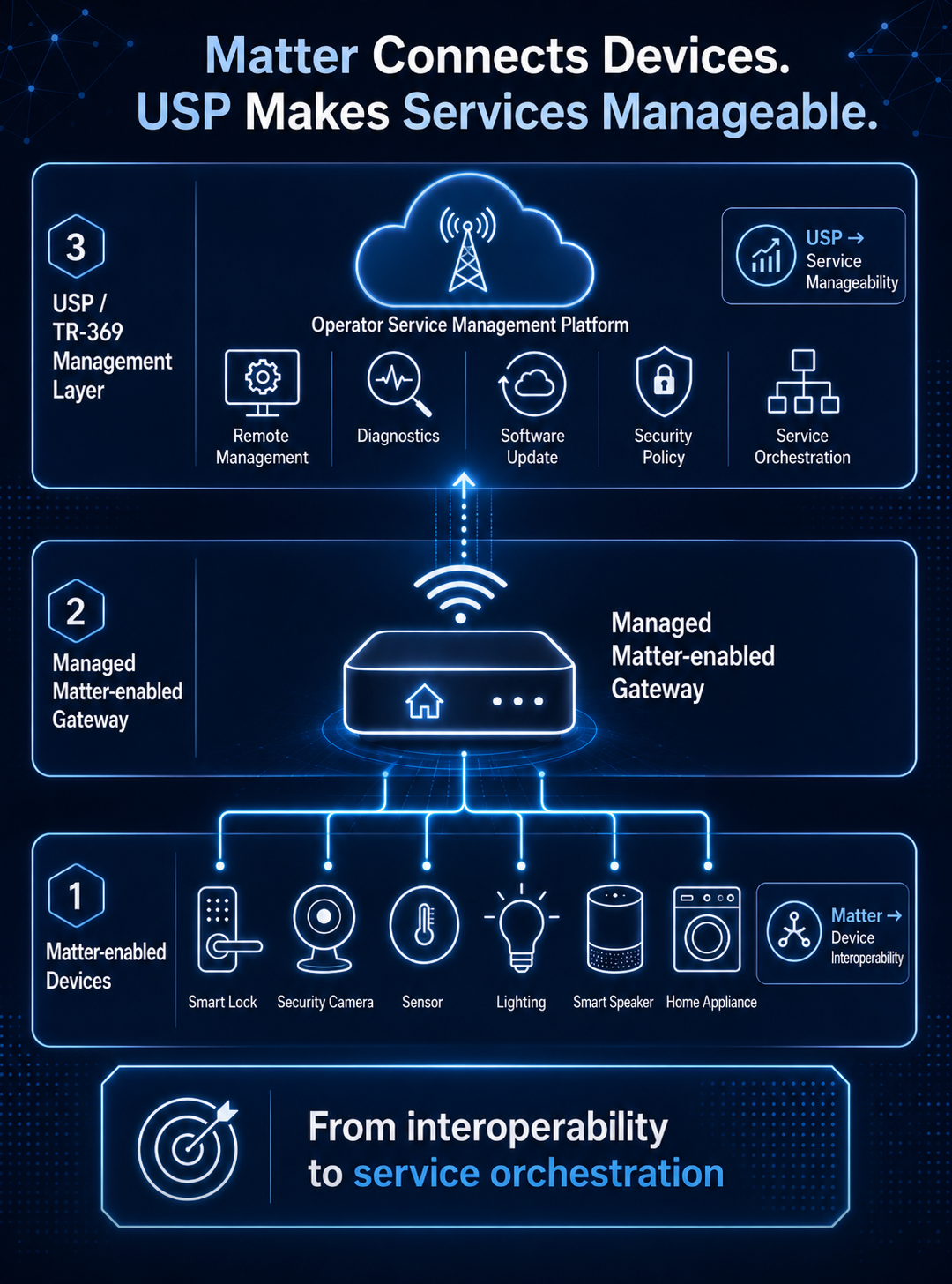
This is where TR-369 / USP becomes relevant. USP is defined as a standardized protocol for managing, monitoring, updating, and controlling connected devices, IoT endpoints, user services, and home networks.
In simple terms:
Matter helps devices work together. USP helps operators manage the services around them.
Broadband Forum has already connected these two directions. It states that Matter and USP collaboration can help network operators and broadband service providers unlock smart home value-added services, including the possibility of simplifying the user experience through a single managed Matter-enabled gateway in the home.
This is the key shift:
The smart home is moving from device interoperability to service orchestration.
For years, the broadband gateway was mainly seen as a connectivity device: access termination, routing, Wi-Fi, and basic home networking.
That definition is becoming too narrow.
The gateway is strategically relevant because it is always on, connects the external operator network with the internal home environment, and can be remotely managed by the service provider.
This makes it a natural node for managed home services. It can help operators understand what is happening inside the home network, diagnose issues, update services, improve Wi-Fi experience, and support connected devices more reliably.
At the same time, the gateway is unlikely to replace Apple Home, Google Home, Amazon Alexa, Samsung SmartThings, or other consumer-facing platforms. Users will still interact with smart homes through apps, voice assistants, smart displays, and platform interfaces.
But beneath the user interface, someone still needs to manage the service layer.
Who monitors connectivity? Who identifies whether a device is offline because of Wi-Fi coverage, device failure, authentication issues, or broadband instability? Who updates home network equipment? Who supports the user when smart home services fail?
This is where broadband service providers may have an opportunity. They may not control every user interface, but they can operate the infrastructure layer that supports the connected home.
The future gateway may not be the screen users see every day. But it can become the service node that keeps the connected home working.
In this context, the gateway becomes valuable not simply because it connects more devices, but because it can make home services more manageable.
The gateway’s evolution is also about software architecture.
Broadband Forum’s WT-492 App-Enabled Services Gateway project aims to standardize software containerization on the residential gateway and give service providers app-store-like functionality for subscriber edge platforms.
This suggests that residential gateways can evolve from fixed-function hardware into flexible service platforms.
The prpl Foundation has also highlighted open home gateway software architecture and a prpl-based application store to support operator and third-party services. Verizon has described the router as evolving from a simple internet gateway into a “central nervous system” for the home, with potential roles in safety, efficiency, and more responsive home services.
Together, these signals point in the same direction: the gateway is becoming a software-defined, service-capable node at the edge of the home network.
That is why the future of the gateway should not be viewed only through speed, Wi-Fi generation, or hardware interfaces. For future CPE design, this means moving from access device to service platform, from speed specification to experience assurance, from isolated hardware to ecosystem-ready infrastructure, and from one-time installation to lifecycle management.
For CPE vendors, the task is not only to provide hardware that meets access specifications. It is to help operators build a more service-ready home access layer — one that can support reliable broadband access, high-quality in-home connectivity, remote service management, multi-service integration, and future connected home applications.
This is where Comnect’s value becomes relevant. With product capabilities across GPON and XGS-PON access, Wi-Fi 6 and Wi-Fi 7 home networking, multi-service interfaces, operator-oriented customization, remote management support, and smart home product extensions such as smart locks, Comnect is positioned to help operators prepare for a more integrated home service environment.