Login

For broadband CPE, energy efficiency is often discussed through a simple question: how much power does the device consume?
However, as CPE configurations become more diverse, this question is not always simple to answer. A basic router, a GPON ONU, an XGS-PON home gateway, a Wi-Fi 7 gateway, or a multi-service CPE with voice, USB and multiple LAN interfaces may have very different functional structures.
This is why the European Commission Joint Research Centre’s Code of Conduct on Energy Consumption of Broadband Equipment – Version 9.1 can be used as a reference document. It provides a structured way to look at broadband equipment power consumption by configuration, rather than treating all CPE products as one generic category.
The JRC document discussed here is Code of Conduct on Energy Consumption of Broadband Equipment – Version 9.1, published in 2025. It is a voluntary Code of Conduct, not a mandatory regulation.
According to the JRC document, its aim is to reduce the energy consumption of broadband communication equipment without hampering fast technological development or the service provided. This point is important because the document is not simply asking equipment to consume less power in isolation; it links energy reduction with continued technical development and service capability.
The document also explains the background for this work. It notes that the growth of the internet has increased the energy consumption of data transmission, and that the potential new electrical load represented by broadband equipment needs to be addressed by EU energy and environmental policies.
The participant list also shows that the Code of Conduct involves both operators and equipment companies. JRC’s official participant page includes companies such as Deutsche Telekom, France Telecom Group, KPN, Proximus, Telefónica, Telenor, Telia Company, Telecom Italia, Nokia, Huawei, ZTE, Cisco, Sagemcom, Genexis and Calix.
A key feature of the JRC document is that it does not define one single power limit for all home gateways or all CPE products.
Instead, it uses a configuration-based approach. A device’s target is calculated from different functional elements, including central functions, access interfaces, Ethernet ports, Wi-Fi radios and additional service functions.
In simplified form, the logic can be understood as:
CPE power target = central functions + WAN/LAN interfaces + Wi-Fi radios + additional functions
This structure is important because different CPE products can vary significantly. For example, one device may include only GPON and Gigabit Ethernet, while another may include XGS-PON, 10GE LAN, Wi-Fi 7, FXS voice ports, USB and other modules.
The JRC approach therefore provides a way to understand how different configurations lead to different calculated power targets. It should not be read as a product performance ranking or as a claim that one technology is inherently better than another.
The JRC Code of Conduct covers a broad range of broadband equipment functions. For CPE, the relevant categories can be summarized as follows:
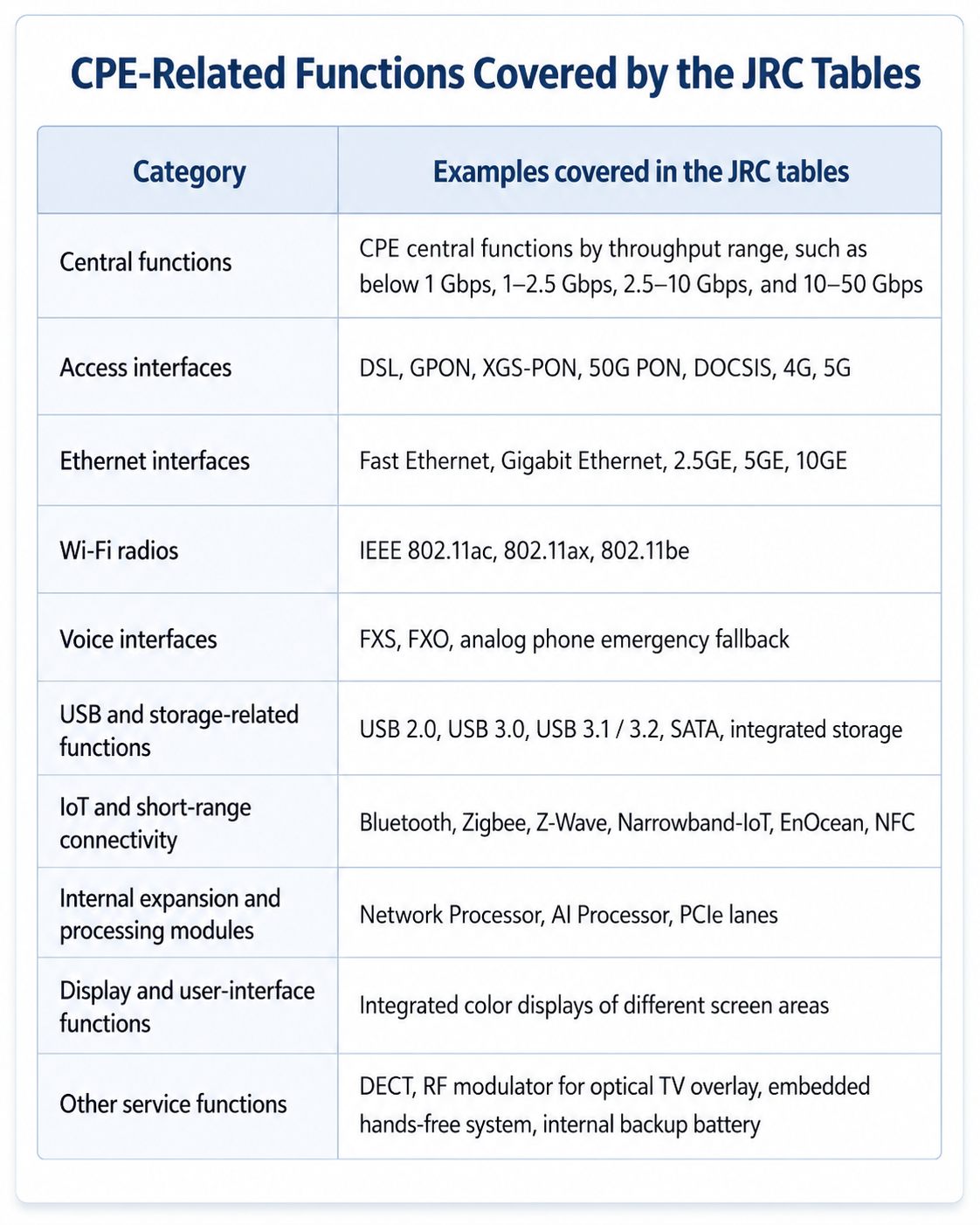
This level of detail is useful for understanding why CPE power targets in the JRC document are calculated by configuration rather than by product name alone.
The JRC document provides examples to show how home gateway power consumption targets are calculated from individual components. One example is an XGS-PON home gateway.
The reference configuration includes:
The JRC example also defines different interface conditions for different states. In Ready-State, two Gigabit Ethernet LAN ports are connected and two are disconnected, while the 10 Gigabit Ethernet LAN port is connected. In On-State, all Ethernet LAN ports are active.
Under the 2025 Tier, the target is calculated as follows:
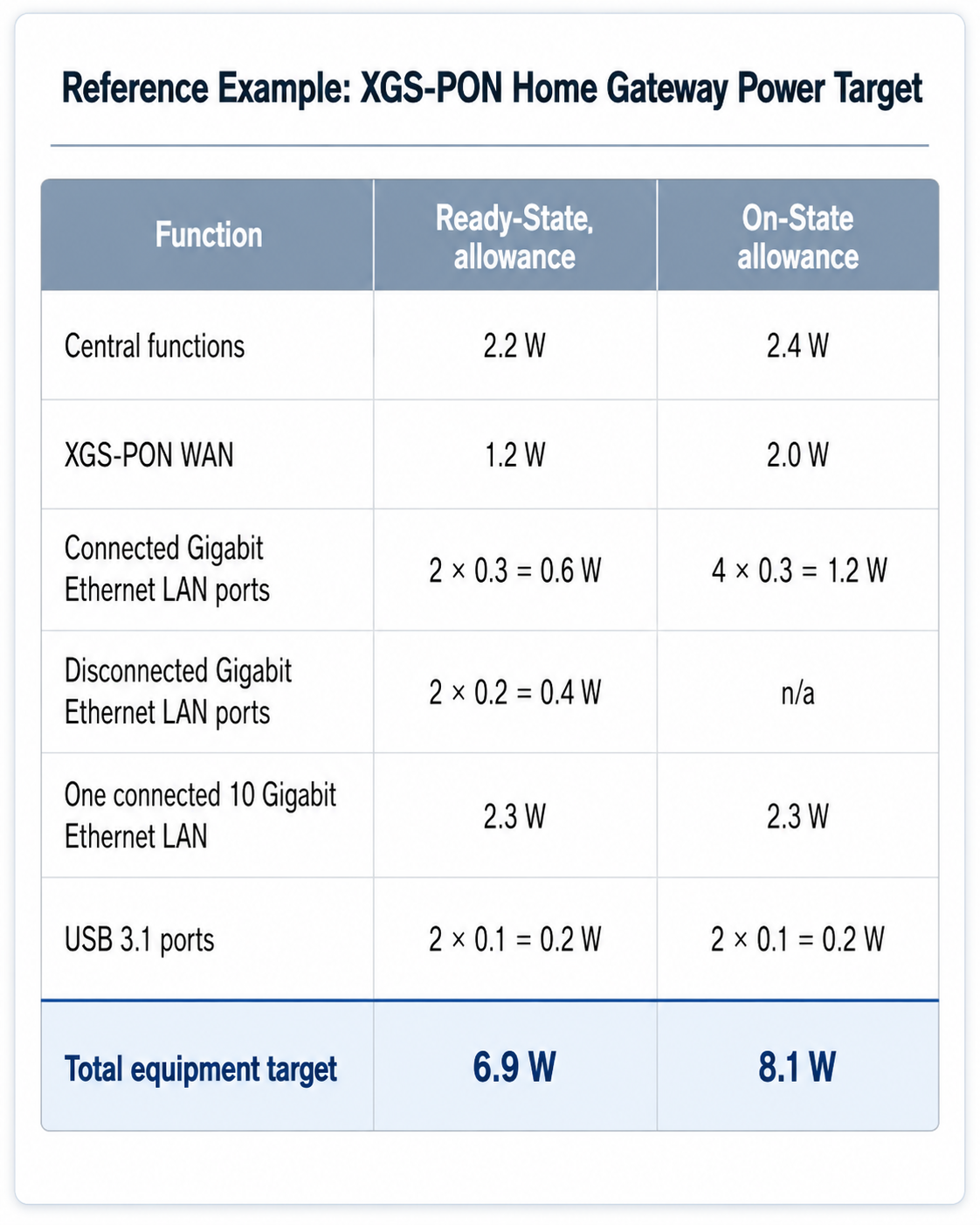
This example shows the calculation method. The target is not assigned simply because the product is a “home gateway.” It is derived from the device’s central function, access interface, Ethernet interfaces and additional functions.
The same method can be extended to other configurations. For example, if Wi-Fi 7 is added, the JRC tables would add a separate allowance for the wireless radio. In the 2025 Tier, a 2×2 IEEE 802.11be radio operating at 6 GHz, 320 MHz and 20 dBm per chain is assigned 2.9 W in Ready-State and 3.2 W in On-State. Additional RF chains, higher output power, voice ports, USB, IoT modules or display functions would further change the calculated target.
The main value of this example is methodological. It shows how the JRC document evaluates a device according to its actual configuration and operating state.
The JRC Code of Conduct should not be confused with mandatory EU regulations.
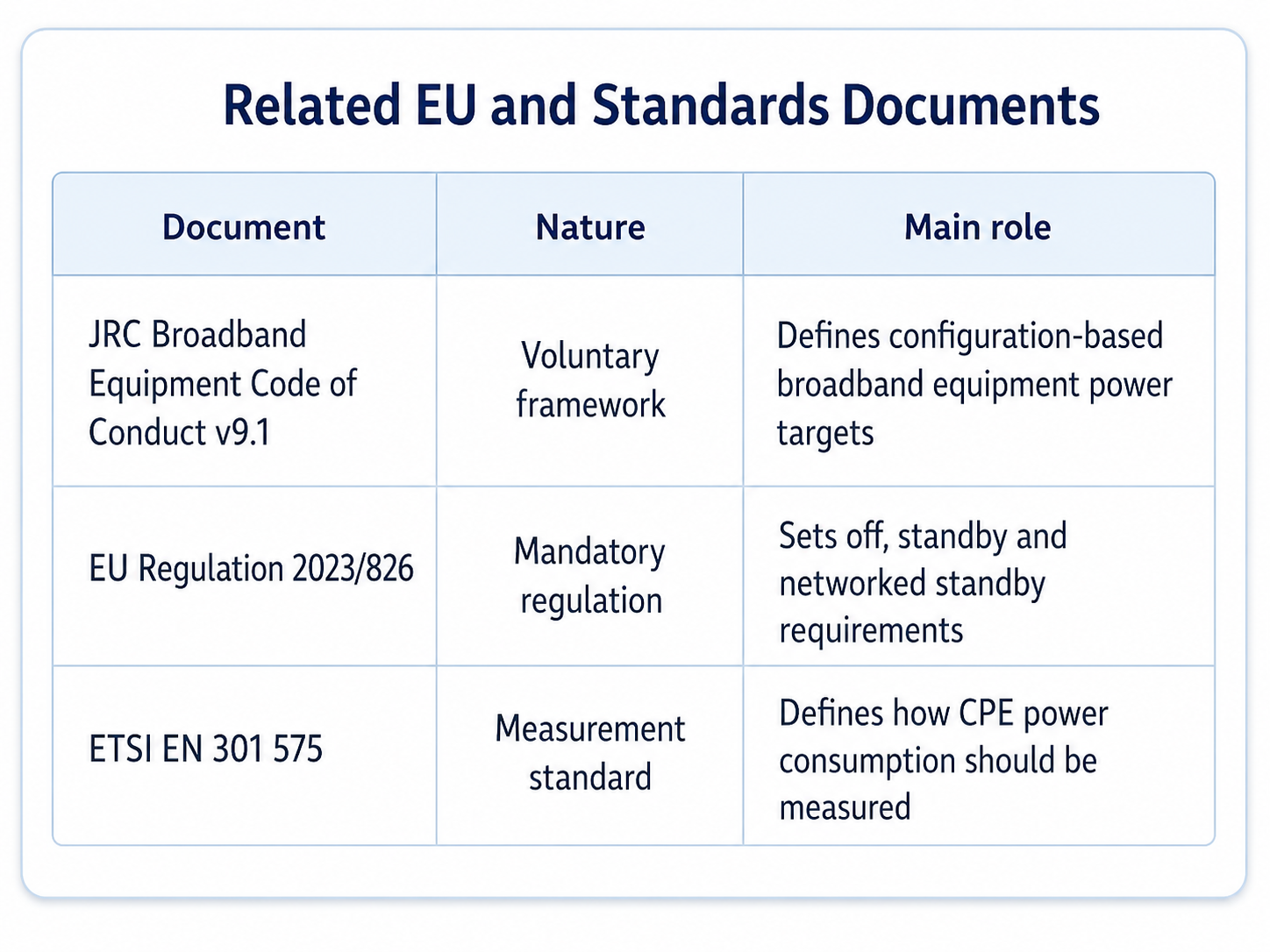
The current EU regulation most relevant to low-power modes is Commission Regulation (EU) 2023/826. The European Commission states that this regulation establishes ecodesign requirements related to off mode, standby mode and networked standby energy consumption for electrical and electronic household and office equipment.
The European Commission’s product information page states that from 2025, standby and off mode limits are 0.5 W, or 0.8 W for standby with information or status display. From 2027, the off mode limit is reduced to 0.3 W, while networked standby limits range from 2 W to 7 W depending on the product type.
This is different from the JRC Code of Conduct. Regulation 2023/826 focuses on low-power modes, while the JRC Code of Conduct provides configuration-based power targets for broadband equipment.
ETSI EN 301 575 is another related document, but its role is different again. ETSI EN 301 575 V1.2.1 defines the methodology and test conditions for measuring the power consumption of CPE, and defines modes such as Disconnect mode, Off mode, Idle states, Low Power states, On mode and Ready mode.
In simple terms:
External power supplies are also relevant because many CPE products use separate adapters. The European Commission explains that external power supplies are used for products including modems and routers, and that current EU rules cover active efficiency and no-load power consumption. The EU page also states that Regulation (EU) 2019/1782 will be repealed and replaced by Regulation (EU) 2025/2052 from 1 January 2028.
Therefore, CPE power consumption in Europe should be understood through several layers: voluntary broadband equipment targets, mandatory low-power mode regulations, measurement methods and external power supply requirements.
Similar Efforts Outside Europe
The JRC Code of Conduct is not the only document related to small network equipment or CPE energy consumption.
In the United States, the Small Network Equipment Voluntary Agreement was amended effective 1 January 2025. The document defines maximum base and additional feature energy allowances and allowance rules for Small Network Equipment used to determine whether a model meets the agreement’s energy efficiency requirements.
This is similar to the JRC document in one important respect: both use allowance-based methods rather than a single universal wattage limit for every device.
Canada also has a voluntary agreement for small network equipment. The Canadian Energy Efficiency Voluntary Agreement for Small Network Equipment, or CEEVA SNE, covers Internet modems, routers and other equipment provided by participating Canadian internet service providers for residential broadband service.
Another related development is the Broadband Forum’s work on power management in device data models. In January 2026, Broadband Forum described TR-181 Power Management as introducing standardized mechanisms for controlling and monitoring the power consumption of embedded network technologies such as Wi-Fi, Ethernet, USB, xPON and Thread when used over a USP/TR-369-enabled network.
This type of work is different from the JRC Code of Conduct. JRC provides power consumption targets, while TR-181 power management relates to how devices can expose and manage power-related information through standardized device models.
What Can Be Concluded from These Documents
A cautious conclusion is that CPE energy consumption is being addressed through different types of documents, each with a different role.
The JRC Code of Conduct is a voluntary framework that provides configuration-based power consumption targets for broadband equipment. Its own stated aim is to reduce the energy consumption of broadband communication equipment without hampering technological development or the service provided.
EU Regulation 2023/826 is a mandatory regulation focused on off mode, standby mode and networked standby. ETSI EN 301 575 provides measurement methodology for CPE power consumption. U.S. and Canadian voluntary agreements provide related approaches for small network equipment in North America.
For operators, vendors and other industry participants, the JRC document can be used as a reference for understanding how different CPE configurations may lead to different power targets. This is especially relevant when comparing devices with different access technologies, Ethernet interfaces, Wi-Fi capabilities and service modules.
The document should not be interpreted as a mandatory global requirement, nor should its influence be overstated. Its practical value lies in offering a structured method to discuss broadband equipment power consumption, alongside mandatory regulations, measurement standards and other regional voluntary agreements.