Login

Today, EasyMesh is commonly seen in the specifications or certification information of broadband CPE, home gateways, ONTs, Wi-Fi routers, mesh APs, and extenders. It may appear as "Wi-Fi EasyMesh," "Wi-Fi CERTIFIED EasyMesh," "EasyMesh Controller," "EasyMesh Agent," or as specific release versions such as EasyMesh R2 or R6.
However, EasyMesh is often misunderstood as simply another way to extend Wi-Fi coverage. In reality, its value is not limited to making Wi-Fi signals reach farther. EasyMesh is about how multiple access points can be discovered, configured, coordinated, optimized, and managed under a standardized Multi-AP architecture. Wi-Fi Alliance introduced EasyMesh to address multi-vendor interoperability in mesh networking, where earlier mesh systems were often tied to a single vendor's ecosystem.
EasyMesh reflects a broader evolution of home Wi-Fi: from isolated routers and proprietary mesh systems to standardized, interoperable, and increasingly manageable Multi-AP networks.
At its core, EasyMesh is a standardized framework for Multi-AP Wi-Fi networking. A typical EasyMesh network is built around two roles: the Controller and the Agent. The Controller acts as the central management entity, while Agents are access points or extenders that follow the Controller's configuration and report network status. prplMesh, an open-source EasyMesh implementation, describes support for Agent, Controller, or both roles, and highlights multi-vendor interoperability aligned with Wi-Fi Alliance certification standards.
This structure matters because a home Wi-Fi network is no longer just one router serving a few devices. In many homes, there may be a gateway in the living room, one mesh AP in the bedroom, another in the study, and dozens of connected devices across different rooms. Without coordination, these APs may overlap, interfere with each other, or lead devices to connect to the wrong node.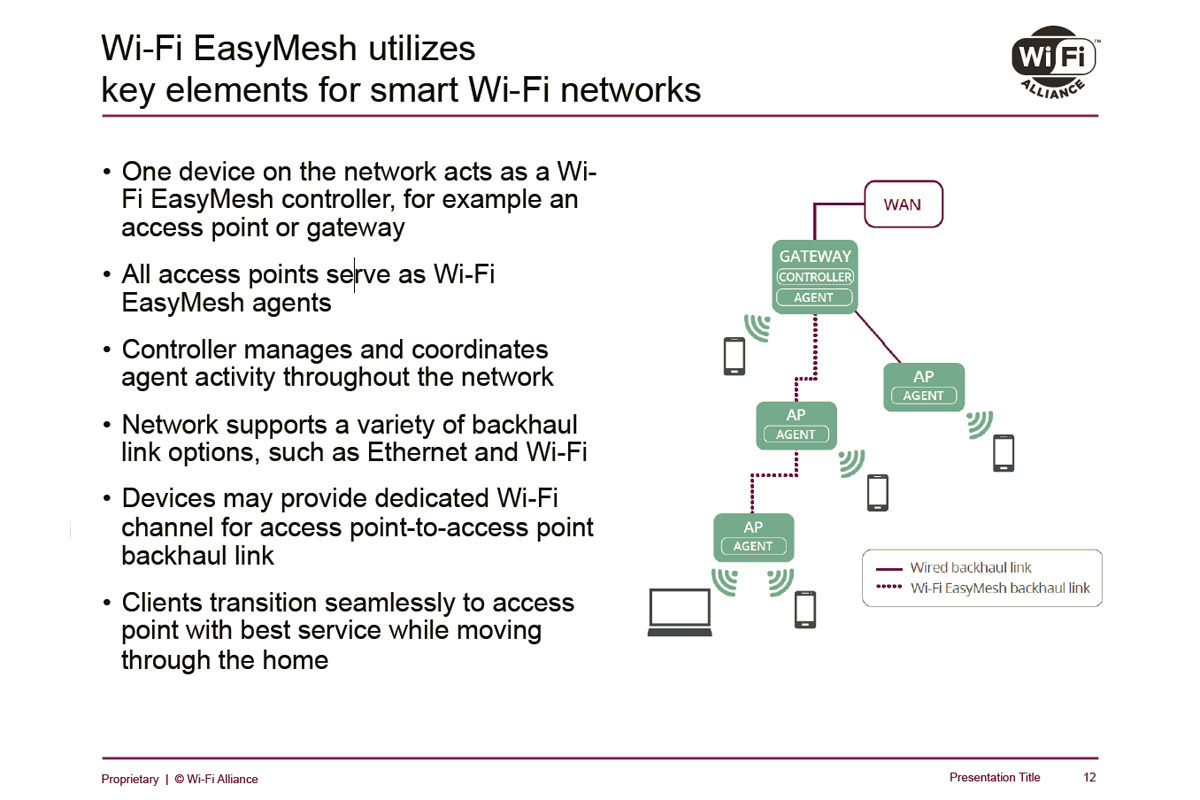
EasyMesh addresses this by standardizing key Multi-AP capabilities such as topology discovery, backhaul and fronthaul management, client steering, channel selection, traffic separation, and diagnostic data collection. In simple terms, EasyMesh turns multiple APs from independent devices into parts of a coordinated home Wi-Fi system.
The "R" in EasyMesh R1, R2, R3, R4, R5, or R6 should be understood as "Release." It is not a simple consumer-facing performance ranking. A newer release does not automatically mean higher speed, wider coverage, or better roaming in every real-world deployment.
A better way to understand EasyMesh releases is to see them as cumulative evolutions of the Multi-AP specification. R1 established the foundation for standardized Multi-AP networking. Later releases build on that foundation by adding, enhancing, or refining capabilities for diagnostics, channel optimization, traffic separation, secure backhaul, remote management, and newer Wi-Fi environments.
To understand the differences between EasyMesh releases, it is more useful to look at how the capabilities have evolved over time. The table below summarizes the major additions and enhancements from R1 to R6.
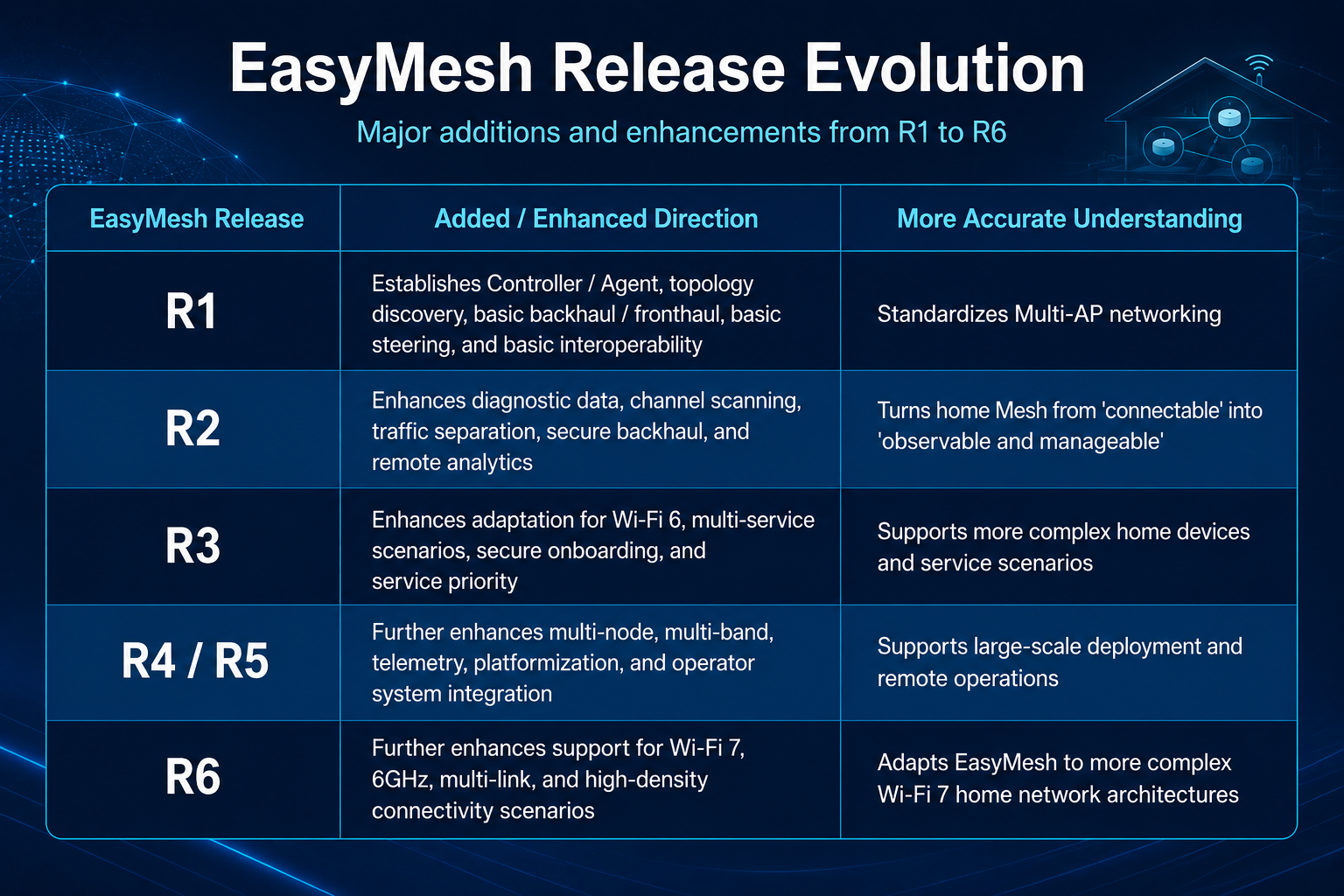
Among these releases, R2 is especially important because it marks a clear shift from basic Multi-AP connectivity to operator-manageable home Wi-Fi. Capabilities such as diagnostic data, coordinated channel scanning, traffic separation, and secure backhaul help operators understand whether a user's Wi-Fi issue comes from the access network, the gateway, the mesh backhaul, channel interference, or client association behavior. CableLabs' analysis of EasyMesh updates also connects these capabilities with operator-managed home Wi-Fi networks.
R6 should also be understood carefully. It does not mean "EasyMesh equals Wi-Fi 7." Wi-Fi 7 is a wireless technology generation, while EasyMesh is a Multi-AP coordination and certification framework. The two can appear together in modern products, especially as Wi-Fi 7 introduces 6GHz, wider channels, and Multi-Link Operation, but they are not the same concept.
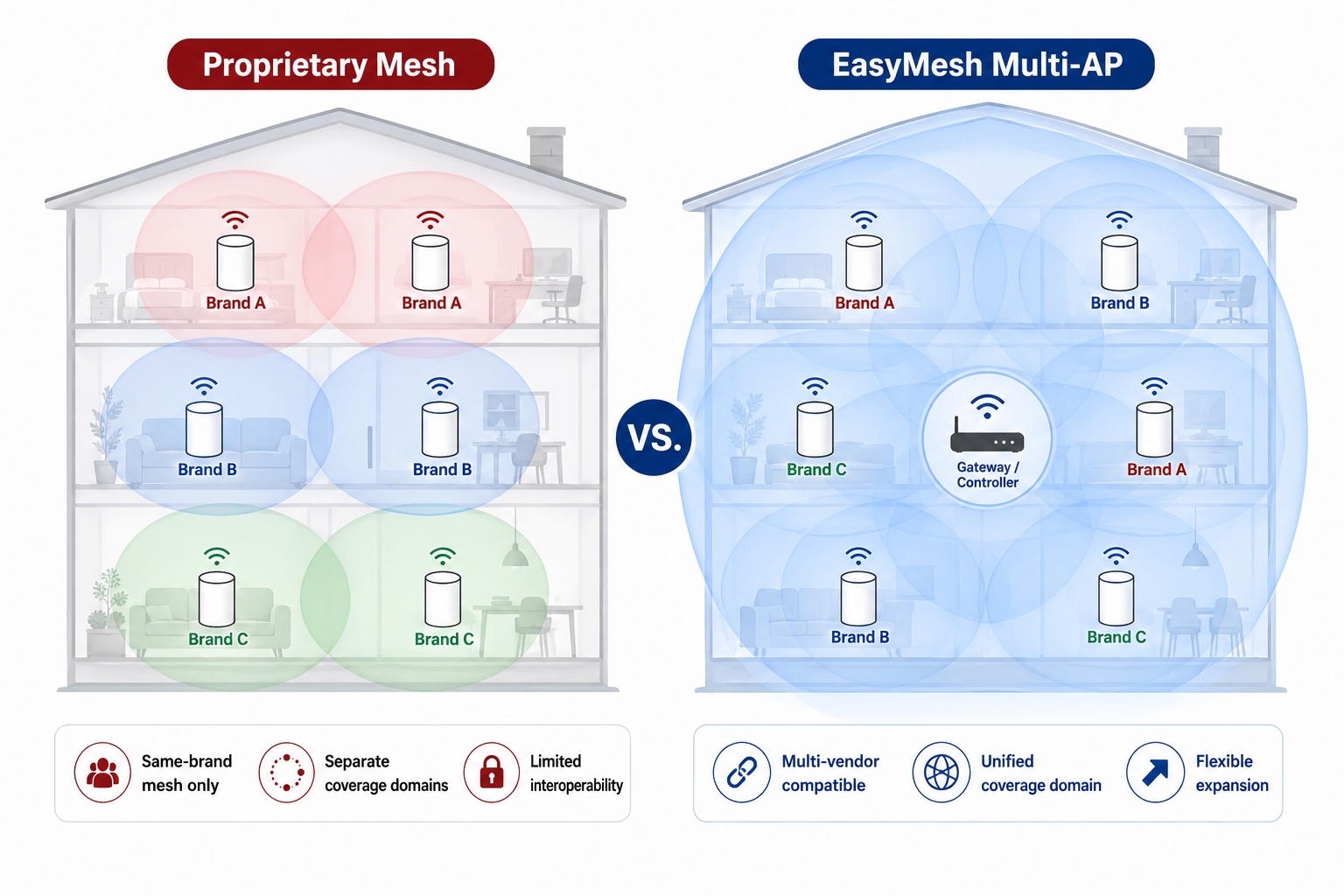
The significance of EasyMesh is not only technical. It also reflects a market shift from proprietary mesh ecosystems to more open, standardized Multi-AP networking. In many proprietary mesh systems, users often need to buy extenders from the same brand to expand the network. EasyMesh was created to reduce this kind of ecosystem lock-in by enabling certified devices from different vendors to interoperate under a common Multi-AP framework.
For operators, the meaning is even more practical. Home Wi-Fi has become one of the most difficult parts of broadband experience to manage. When users complain that "the internet is slow," the problem may not be the fiber access network. It may be poor AP placement, weak wireless backhaul, channel interference, device roaming behavior, or too many devices connected to the wrong band.
This is why EasyMesh evolved beyond simple coverage extension. Diagnostic data, channel scanning, traffic separation, and secure backhaul are not decorative features. They are the foundation for making home Wi-Fi observable, manageable, and serviceable. CableLabs' analysis of EasyMesh updates clearly connects these features with operator-managed home Wi-Fi networks.
There is also a broader technology context. As Wi-Fi enters the Wi-Fi 7 era, home networks are becoming more complex. Multiple bands, 6GHz, wider channels, Multi-Link Operation, more IoT devices, home office applications, cloud gaming, and low-latency services all increase the need for better coordination. In this environment, the performance of home Wi-Fi is no longer determined only by the peak speed of a single router. It depends increasingly on how the entire Multi-AP system is coordinated.
This direction is also aligned with broader research around next-generation Wi-Fi, where multi-AP coordination is discussed as a key capability for improving performance in dense and overlapping Wi-Fi environments.
This is the deeper value of EasyMesh: it is not just a way to expand coverage, but a step toward treating home Wi-Fi as managed infrastructure.
For operators, home broadband is not delivered through access speed alone. It is delivered through a complete service package: the access gateway, in-home Wi-Fi coverage, mesh expansion, device management, and the user experience across different rooms.
This is why EasyMesh is important from a service packaging perspective. A basic broadband package may only require a single gateway. A larger home may need one gateway plus one mesh AP. A premium Wi-Fi package may include a Wi-Fi 7 gateway and multiple mesh nodes. In all these cases, operators need the devices to work as one coordinated home network, instead of a group of separate products.
For product manufacturers, this makes EasyMesh support across the product portfolio more valuable. When ONTs, routers, and mesh products can all support the same Multi-AP framework, operators gain more flexibility in building different service packages. They can combine access devices and in-home Wi-Fi devices according to household size, service tier, and user demand.
This is also where CPE vendors can create practical value beyond single-product specifications. Comnect provides EasyMesh support across its broadband product portfolio, including ONT, router, and mesh product lines. For Wi-Fi 7 products, support for newer EasyMesh releases such as R6 can further help operators build Multi-AP home Wi-Fi environments for next-generation broadband services.
In this sense, EasyMesh is not only a technical certification. It gives operators a more flexible way to design, package, and scale home Wi-Fi services. The value lies not only in whether one device supports Mesh, but in whether the entire product portfolio can support a coordinated Multi-AP service model.
EasyMesh enables home Wi-Fi to evolve from isolated APs and private Mesh systems to a standardized, interoperable, observable and manageable Multi-AP network.
From R1 to R6, the key story is not a simple performance ladder. It is a cumulative evolution of capabilities. R1 made standardized Multi-AP networking possible. Later releases added and refined diagnostics, channel optimization, traffic separation, secure backhaul, remote management, and support for increasingly complex Wi-Fi environments.
As Wi-Fi moves into the 6GHz, Wi-Fi 7, and multi-link era, the challenge for home networks will not only be higher peak speed. The bigger challenge will be whether the entire home Wi-Fi system can be coordinated, diagnosed, optimized, and managed as one network.
That is why EasyMesh is not just Mesh. It is part of the broader evolution of home Wi-Fi from coverage extension to managed Multi-AP infrastructure.